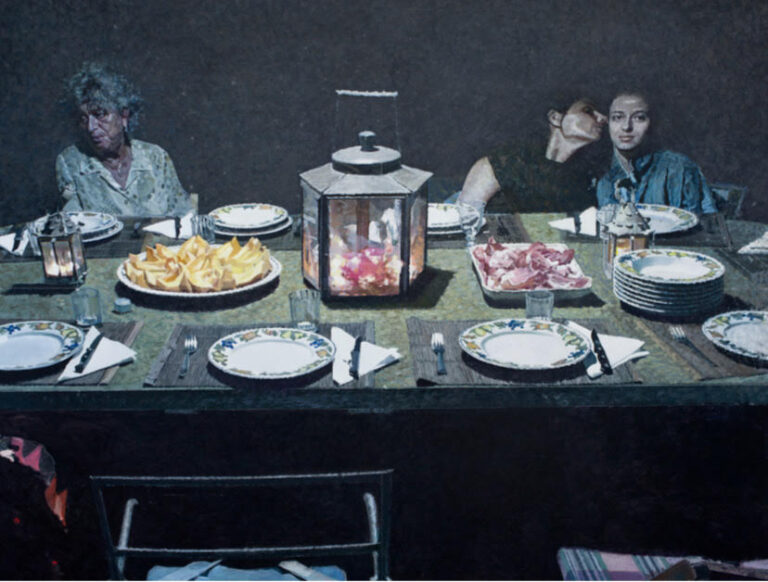
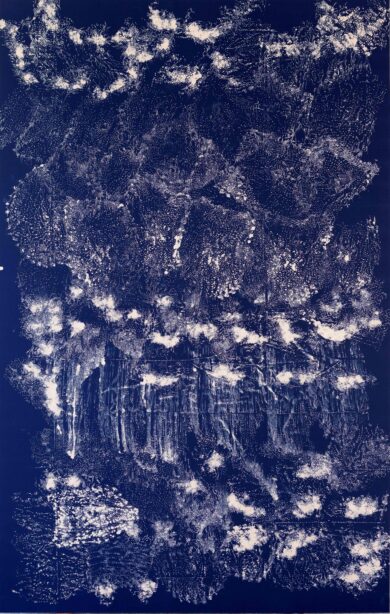
“In an extraordinary way”. About a series of portraits by Bernardo Siciliano
For the very same reason that prevents us from seeing the movement of a clock’s hands or a bud unfolding, we are unable to realise the ceaseless change in our features, from birth to death: a steady flow that knows no interruption, makes no distinction between sleep and wakefulness, and turns our face into a sort of hourglass. It is one of the many cases where nature has endowed us with a providential limitation of our senses, because perceiving the slowness of the transformation processes in which we are immersed would probably lead to madness and the inability to adapt to the world. With the deceptive comfort of habit, we make up for this excess of instability that pervades the visible, and we are able somehow to recognize our own face in the mirror each morning and distinguish people we know from strangers. To judge whether a person has aged, we need a reassuring interval of months or years. Viewed from this perspective, every portrait is a deception, the image of something that can never happen, a trompe-l’oeil. When Milly Theale, the heroine of Henry James’s Wings of the Dove, contemplating Bronzino’s portrait of Lucrezia Panciatichi, says to herself «I will never be better than this», she is thinking neither of the beauty nor of the impeccable bearing of the Florentine lady, but expresses the envy that mortals feel for the images of their fellow men removed from the inexorable laws of the time. What else were the Gods and their visible forms to the ancients?
Bernardo Siciliano has collected a long experience regarding the psychological drama implicit in the portrait. Throughout his career, he experimented with techniques and formats, making the most, like many of his contemporaries, from model photographs. Yet he has never forgotten that sort of ordeal, a ‘big game hunt’ if you will, with just one shot in the barrel, which is a live sitting, with all the ungovernable circumstances that entails. There is a recurring need for this experience, which is both intellectual and physical. No mediation, no protection. It is the hand that establishes the proportions of the face, relying on the eye, in a kind of race against time. Those who are unfamiliar tend to believe that the greatest difficulty lies in the impatience of the models: how did the good Velazquez manage to keep the Infanta Margherita and her two meninas still, not to mention the dwarves and the mastiff? And in many movies we see the painter begging: «stay still! five more minutes! ». Actually, this is a simple matter of patience: models give in easily, and tend to sit still more than you think. The real critical point is the artist, especially in the very delicate phase of drawing. Because there is nothing to be done: in the art of portraiture, one’s talent for drawing is stretched to the very limit, I would say almost to the breaking point, like the muscle engaged in the most difficult exercise. No one knows better than the artist that the human face, if one were to find a comparison for this prodigy, is a film that never stops. And so, the artist must perform an acrobatic feat, one that demands dexterity and timing: to break into the perpetual evolution of a face and steal from it that fleeting configuration which does not exist in nature, yet guarantees every human being the necessary illusion of resembling themselves more than they are transformed. You have to land on the tip of a pin and detach from it just as quickly. And the rules of the game don’t change much, although they take on an interesting nuance of dissociation and schizophrenia, in the case of the self-portrait, where the field of incursion is the surface of a mirror.
Having admired this new series of charcoal drawings by Bernardo Siciliano, we can only agree with Giacomo Leopardi when he states that the “effect” of a portrait, from an aesthetic point of view, is greater than that produced by the “person represented” in flesh and blood: whether they are particularly beautiful, or the opposite. Because seeing that persons, the great poet argues: «we see them in an ordinary way», while their portrait allows us to see them «in an extraordinary way», such as to awaken the “acuteness” of our observational skills.
I would go even further: as the models’ features emerge on the surface, in this series so uniform in its intentions and results, there is a veritable state of emergency, as if the energy expended in the search for a likeness of a human being were to produce an inner reflection akin to a surprise, or perhaps, better still, a fright that must be controlled. And this backlash is by no means a limitation of representation, nor is it in any way a by-product, but rather the trace of a relationship between living beings. And of that uncertainty of the outcome that can never be expelled in the game of contrary forces of beauty.