TEXTS BY
Eugenio Alberti Schatz e Denis Curti
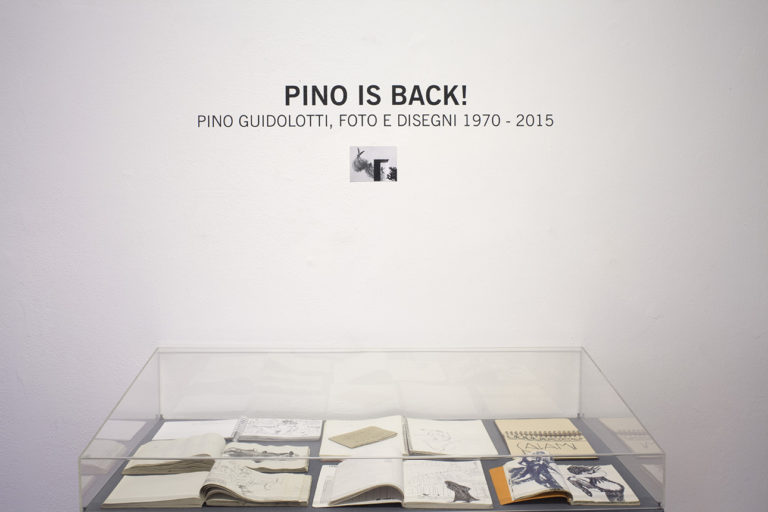
Pino Guidolotti, a versatile and unconventional artist who has captured an entire generation through his eyes of a protagonist, is back with recent and previously unexhibited work.
Leading fashion photographer in the 80s and 90s, Guidolotti has portrayed celebrities, artists, directors, architects, designers and actors; he ha salso masterfully conveyed iconic places, architecture and great sculpture from Palladian Villas to the work of Bernini.
True audacity lies in being entirely oneself.
— Man Ray
A sharp, restless gaze—forever unsatisfied—that digs, scrapes, and investigates like a trained Italian hound in search of a white truffle. Pino Guidolotti navigates that fine strip of land between art and photography—a space that might seem mainstream today but was anything but in the 1980s. There’s a certain lightness to his approach, a detachment from technical obsession, a refusal to feel bound to delivering the “perfect shot,” and above all, the courage to break free from genre constraints (truth be told, he couldn’t care less about genres).
His irreverent spirit is present in his work, in his life, even in conversation—where he seems to weigh more carefully the words he won’t say than those he does.
Guidolotti chases the meaning of images like a rider galloping across open plains. His driving forces seem to be curiosity, the joy of discovery, a rejection of mental cages, and a mysterious sense of beauty—not to mention the utter freedom with which he chooses themes and subjects.
This explains the delightful unpredictability of his photographic campaigns: two swimmers captured from above, as though the photographer were drifting over them in a balloon; a celebrated stage actress posed like a figure in an Amsterdam window; a couple—an actor and a writer—framed with their toes in the foreground; a photo session at a water park on the Côte d’Azur portraying the slaves of leisure, perhaps anticipating Adrian Paci’s metaphysical-social sensibility—or perhaps linking back to Savinio and Sironi; a melancholic model gliding like a swan across marble floors…
Architecture—so much Palladian architecture. Sculpture—so much impassioned sculpture, especially Bernini’s, where marble becomes marzipan. And faces—countless faces—a whole gallery of portraits, each one captured with a quid that recalls Leonardo Sciascia’s intuition: photography’s unique ability to grasp an individual’s entelechy, the inner drive toward self-realization.
Guidolotti studied art before stepping into the arena of photography, where he often circled back to art itself—his friendship with Gombrich being a notable example. And when he finally put the lens away, art came back for him, grabbing him by the collar like a rubber band snapping back. He returned to drawing, sculpting with rusted and stony materials from the Salento, sketching film stills from life… After all these years, his eye remains hungry for beauty. He hasn’t forgotten the golden ratio, and he continues—humbly—to serve an ideal of harmony that surely exists somewhere, near or far. An ideal that humans, by their very nature, cannot help but dream of.
This is the wonderfully simple lesson of a master.
Welcome back, Pino.
“Perhaps one day photography, if we allow it, will show us what painting has already revealed: our true portrait. And it will give lasting form to the spirit of rebellion that exists in every truly alive and sensitive being.”
— Man Ray
In recent years, you’ve travelled often to India. What did it mean for you?
India introduced me to smells. I visited for eight years in a row, staying twenty to thirty days each time. I read Indian symbology manuals, but little of it stuck—I suppose I didn’t try hard enough. To be honest, the esoteric side never interested me much. I was there to photograph.
The project was conceived with John Eskenazi, one of London’s foremost dealers in Oriental art. I met him when Vogue commissioned a portrait of him and his father, an antique dealer in Milan. We spent a lot of time discussing the point of view—how to avoid interference from urban furniture, what kind of light to work with, especially since we were shooting during what I call the ‘plastic sky’ season, where the light is flat, cloudless, like a Coop supermarket bag.
India means travel, fatigue, endless movement—not every day ends at the Taj Mahal. Still, nothing compared to the ancient effort it took to create such wonders. Sometimes you arrive at a site, a temple or a cave, and you can’t help but wonder how on earth they managed to carve all that armed with just a chisel.
What emotions does Indian sculpture stir in you—as someone who has so masterfully photographed Bernini’s statues?
Indian sculpture is deformed. Bernini always maintains human proportions, respects mathematics, follows a consistent form and syntax. In India, on the other hand, we have swastika-shaped dancers in perpetual motion, obese Ganesh figures with trunks, and elegant, still Shivas who gaze down with a faint smile. They look like radiators.
I believe there is a link between these two worlds—we just need to uncover it. After all, these are all human artifacts.
Let’s move back in time. What was your relationship with fashion? Did you enjoy shooting fashion stories?
It was a job like any other. In the late ’80s, I worked regularly for magazines. I had to shoot a story every week. I had a great working relationship with Vittorio Corona, editor of King and Moda. They gave me total freedom—precisely because I was an outsider to the fashion world. I hadn’t even shot a single lookbook for a designer! What interested me was the scenographic side of things, the theatrical mise-en-scène, if you will. In short, I was privileged.
One of the strongest threads in your work is the portrait—of people linked to architecture, art, literature, theatre… Why this fascination?
Portraiture begins with an encounter. You shake hands, you sit down, you have a drink, you start talking… Often, the portrait becomes a visual autopsy of someone’s environment—their home, their studio. Sometimes I would spend the entire day with a person just to get one shot.
And then there’s always someone who nudges you in a certain direction. Things don’t happen by chance. Renato Olivieri—writer and creator of Inspector Ambrosio, played in film by Ugo Tognazzi—was editor of Millelibri, a supplement of the Giorgio Mondadori publishing house. He encouraged me to photograph writers at home. That’s how I ended up shooting Sciascia in Racalmuto, Eco in Milan… Sciascia was very kind and patient with me. Only later did I find out he was already very ill.
Then came the designers—Ettore Sottsass, Aldo Cibic… and later, the artists. I remember going to via Paolo Sarpi in the evenings to meet Mario Merz, who was always furious with humanity. Cultural figures are egocentric, and they’ll only agree to be photographed if they know the image will end up in a magazine. Otherwise, it’s hard.
At a certain point, you left Milan. Why?
Milan no longer gave me anything. I’d look at the bridge on via Farini and the low railway building beside it and feel like I was in the suburbs of Bratislava. To lift my spirits, I’d stroll through the Monumental Cemetery—so many nude women there, even if they’re made of marble…
And so you retreated to Minervino, in Salento. It’s hard not to see it as a kind of self-imposed exile, a personal Aventine Hill. How did you adjust to post-Milan life?
It took some time to settle in. For a while, I stopped taking pictures. Then, gradually, I started looking around again and picked up the camera. Old photographers photograph trees. After the trees, there was Giuseppe—the gardener. A real character, a bit of an anarchist, a voracious reader, once a PE teacher. Not easy to get along with. He reminds me of my father—infinitely patient, yet always angry and trapped in a life he didn’t choose (my father was a butler). I think Giuseppe is my alter ego.
The other exception was a hunter who rode a bicycle. I liked how he carried himself, and I felt the urge to photograph him. I asked him to aim his rifle toward the sky. Both gave me great satisfaction. In the South, people still have a solemn view of the image. They pose with dignity—like savages or like us in the 19th century. They’re not afraid of stillness. In fact, they adopt a beautiful posture.
Hard to believe you stayed still for long…
Indeed, I cauterized the separation from photography by returning to drawing. I was born drawing, so it wasn’t difficult. It’s like when something you thought lost at the bottom of the sea resurfaces once you remove the weights. It’s a natural resurfacing.
After all, I never forgot the golden rectangle from my scenography studies. The photographic frame is the same. Even to look at a photo, you need the right distance—it’s a proscenium. Like in theatre, where the optimal viewpoint is one and a half times the diagonal.
Oh—and there was a third exception: the photo of my niece Nina’s bath, when she was just over a year old. It looks like a baptism. That’s the last photo I remember.
Has this exhibition at Assab One made you want to return to photography?
Yes, I’d like to get back behind the lens. And I want to buy an analog camera. But my approach has definitely changed. These days, things find me—they come toward me. I don’t go looking for them anymore.
Giuseppe is here, and he’s my mirror—I see myself in him. Smells find me, they tell me stories. I’ve read three books on mathematics, even though I don’t understand numbers. The Fibonacci sequence fascinates me, and I’ve discovered that trees, in some way, follow it. And chess—that game I never had time for… You can’t die without knowing how to play.
Speaking of influences—what photographers have felt close to you?
Romeo Martinez was like a godfather to me. He was an incredible catalyst at the international level. We spent a lot of time together, and thanks to him I met some of the greatest photographers in the world.
Then there was Paolo Monti, a true Bocconi man—highly cultured, and with something extra, even though he started out as an amateur. Willie Ronis was very intelligent. I liked Enzo Sellerio—he was tall, handsome…
And your broader cultural lineage? The masters you looked up to?
I’ve always been drawn to surrealist photography. Certainly Man Ray. And also Manuel Álvarez Bravo—he fascinated me deeply.
Why did you first turn to photography?
For me, and others like me who grew up in the provinces, photography was a way out—a means of escape. One of my first photo essays was in Marseille. I had no money, slept in the train station, ate bread and potatoes, and wandered the docks watching ships. It was a way of saying—without saying—that I wanted out of my provincial world. Don’t you think?
Thanks to your camera, you’ve made some important friends. Like Ernst Gombrich.
Yes, it’s a beautiful story—our friendship lasted for decades. He and his wife Ilse became very fond of me, maybe because I, like them, was a migrant. I drank in every word he said. Listening to him was a rare privilege.
He used to say he wrote his books with a single reader in mind: Panofsky. In 2002, the Warburg Institute held a commemorative event, and my portraits from 1977 to 1996 were exhibited. They used a photo of him for the invitation: Gombrich standing on a library ladder, holding open a large folio. The perfect image of a man of culture—trying to elevate himself and others.
What do you think about the overwhelming circulation of images today?
People are better at looking now—they have more visual literacy, more tools. No doubt about it.
And looking is easier than reading. But I wouldn’t be too optimistic. All these images—they’re beautiful and horrific at once. Billions of photos taken with phones. Just think of the images sent out by ISIS. They’re pornographic in a way. They show you what you shouldn’t—or don’t want to—see.
At its core, what is a photograph?
It’s a copy of life. If you learn to copy well, maybe you’ll become a creator over time. But it’s also a place of solitude and silence.
Unlike cinema, where you’re always surrounded by people—it’s like a school trip: shouting, arguing, giving orders, negotiating. Photography is a message that needs to be deciphered; some things are marked on it.
A painting is a living object—it senses changes in light. Photography is a corpse—a beautiful, pure object.
Have you ever photographed someone who had passed away?
My father. It’s a photo I like. The subject wasn’t moving—so it wasn’t hard.
He’s buried in Montefiascone, where the funeral was held. Let me tell you a story about that—it’s something Danilo Kiš would have appreciated.
You know I’ve always had a soft spot for Curzio Malaparte. There was a time when you couldn’t say that out loud—he was labeled a fascist. While reading his biography, I discovered that when the hospital van carried his coffin from Rome to Prato, the drivers stopped in Montefiascone for a meal.
I can see it clearly: the drivers stuffing themselves while Malaparte lies dead in the van outside.
And your relationship with young people?
I’m always out of sync. But they’re my ideal readers.
Earlier, you said you were born drawing. What exactly did you mean? And how did you move into photography?
I used to draw on marble tables, at my grandmother’s house. I copied comics. Sailboats—I adored drawing sailboats.
Back then, in Verona, the only two photo shops had lavish window displays filled with German cameras—Leicas, Rolleiflexes.
And for the poor, there was the horrible autarkic Bencini camera. Needless to say, my first camera was a Bencini.
Only in Bologna, while at the Academy, did I finally get my hands on a Nikon F.
What do you remember about your studies at the Bologna Academy?
It was 1968. There were assemblies all day long. I had come from Verona and spent my mornings in cinemas watching matinees.
To give you an idea of the atmosphere: at my scenography exam, I brought in a text by Marivaux, filled with my notes. When they asked me to summarize it, I refused. I said that the marked-up script was my work. I didn’t get my diploma.
But the professor later hired me as an assistant at the Teatro Comunale in Bologna.
Do you remember your first photo exhibition?
My father’s family is from the Viterbo area—specifically Capodimonte, on Lake Bolsena. My uncle was the head of the fishermen there. Capodimonte had a small slaughterhouse where cows and pigs were killed.
Blood and death never bothered me. I shot in black and white. I exhibited the photos at the Bologna Academy, where I was studying.
Are there any places you still dream of visiting?
The North. I dream of going North. Northern Scotland, for example.
So you’re searching for rarefaction. Then it’s not true that you’re fierce?
At the end of the day, I’m a gentle person.
Martinez is, in my humble opinion, the father confessor of many photographers
who came to him begging for absolution. His greatest sin is never having asked
them for any offerings for his worship of photography. He knows each of us better
than we know ourselves.”
Henri Cartier-Bresson.
It’s hard to place Pino Guidolotti within the strict categories of photography—landscape, portrait, reportage, street photography, fashion, still life…
He moves fluidly between them all, like a decathlete achieving excellence in each discipline. Once a promising footballer—though ultimately a missed vocation—he became a central figure of the Milanese photography scene in the 1980s, only to withdraw from it entirely, retreating to the sun-drenched lands of Puglia.
A draughtsman, photographer, and storyteller, Guidolotti is today the undisputed master of subtraction. Not only because he stepped away from photography, but because his entire practice—whether in drawing or in black-and-white images—is rooted in poetic reduction. His work embodies a rare and noble exercise in removing the superfluous, relentlessly pursuing essence.
And yet, that lingering Venetian inflection still gives him away, makes him seem less plausible. Spend a little time with him, and you realise he’s always yearning to be somewhere else. Restless, solitary, curious. But if you probe a bit deeper—with patience—you discover that’s not quite true. He remains poised, on the edge of an imaginary photograph, watching, sniffing the air, sizing you up. And if he decides you’re really there, he springs into motion like a pinball and begins to tell his stories.
The first thing he mentions is Romeo Martinez (hence the opening quote). They were friends, just as he has been (perhaps still is?) close to some of the greats in photography, art, literature, cinema, and theatre. With Martinez—the brilliant editor of Camera magazine in the ’50s and ’60s—Guidolotti shared a spirit of creative complicity that also echoes the rigour and austerity of Paolo Monti.
Yes, the path is winding. I’m aware of it. But it is from the roughness of things, from the friction of thoughts, that certain images are born. Guidolotti’s is a total photography—images that, I believe, stem from an inner urgency. He expresses himself through precise aesthetic criteria, forging connections and relationships that give shape to a transversal sentiment—one capable of conveying harmony, balance, and perhaps even a sense of fragility.
Maybe that’s why he left. Maybe that’s why he came back.
Denis Curti – March 2015
Pino Guidolotti is one of the most famous Italian photographers. During his career he has worked with major Italian newspapers and publishing houses ranging from fashion, portrait, architecture. Moreover, he has devoted his attention above all to art and reproduction of the artistic heritage, also influenced by the his long friendship with Ernst H. Gombrich.
MONOGRAPHS
A.Rosenauer, Donatello. Opera omnia, Milan 1993.
R.Wittkower, Bernini. The sculptor of the Roman Baroque, Milan 1990, London 1997.
Beltramini. Andrea Palladio: Atlas of Architecture, Venice 2000.
G.Beltramini e H.Burns. The Venetian Villas, Venice 2005.
M.A. Avagnina. The Teatro Olimpico in Vicenza, Venice 2005.
Progetto Viven, 200 Venetian Villas
Davide Gasparotto, The horses by Francesco Mochi.
John Eskenazi, The Classical India sculpture.
SOLO EXHIBITIONS (selection)
2014. Inaugurazione di me stesso, Cinema del Reale, Specchia (LE)
2006. Volti di Architetti, Yellow Fish Gallery, Montreal.
2006. Volti di Architetti, Centro Palladio, Vicenza.
2005. Le Ville Venete, Centro Palladio, Vicenza.
2003. Carlo Scarpa. L’opera, Centro Palladio, Vicenza.
2001. Le ville del Palladio, Centro Palladio, Vicenza.
2001. Memorial E. H. Gombrich, Warburg Institute, London, U.K.
2001. Pino Guidolotti, Galleria Il Diaframma, Milan.
2001. Pino Guidolotti, Casa del Mantegna, Mantova.
2001. Pino Guidolotti, Photographer Gallery, London, U.K.
2001. Pino Guidolotti, Musèe Reattu, Arles, France.
2001. Photographie Italienne, Chalon sur Saone, France.
2001. Pino Guidolotti, Galleria Il Diaframma, Milan.
1974. Pino Guidolotti, Krakow, Poland.