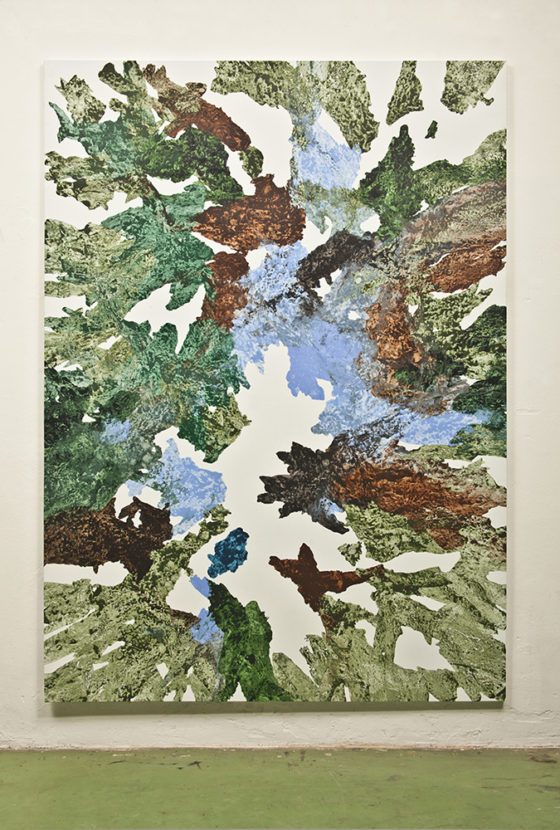
The date of the exhibition is drawing near. Elena tells me I should write somethinf for the exhibition.
So I go back to the beginning—when I first called her to ask if she could host some future paintings. The Roland Ultra printing press had just been dismantled, ready to be shipped to India, where it has recently resumed activity.
I had in mind to make large monotype prints, right in the space where the machine once stood, at Assab One. Elena had seen some colorful paintings in the studio, and we agreed to embark on a new adventure.
So I begin: I move into Assab and spend the whole month of July working on site.
I look at the black, oily surface (about 20 square meters) where, for over thirty years, the press printed books, encyclopedias, posters…
The floor still sweats oil—drops that once ran down the ribs of the machine and spread downward. How many words and images might it remember?
In the meantime, I’ll need to cover everything with a light sheet of plastic. The oil can remain in the floor. I want to create new images: taller, more dreamlike, more… somewhere else. The memory of the oil must stay in the floor, in its material. I must paint new works in this space—not conduct an anthropological study through its lingering marks.
I need to recall how the machine operated, how it was programmed, how much ink was needed for a print.
Is it possible to make paintings as if they were made by a machine—with that same blind energy? To arrange colors directly on the surface of the floor and become the Roland myself, letting these new images emerge, the product of my mechanical thinking?
What comes out are paintings that seem like printed dreams—as if by neutralizing thought, dream activity takes over. A kind of butterfly hunt—dream-paintings, hopefully more alive.